Chakras and Frequencies - Ancient Wisdom Meets Modern Neuroscience
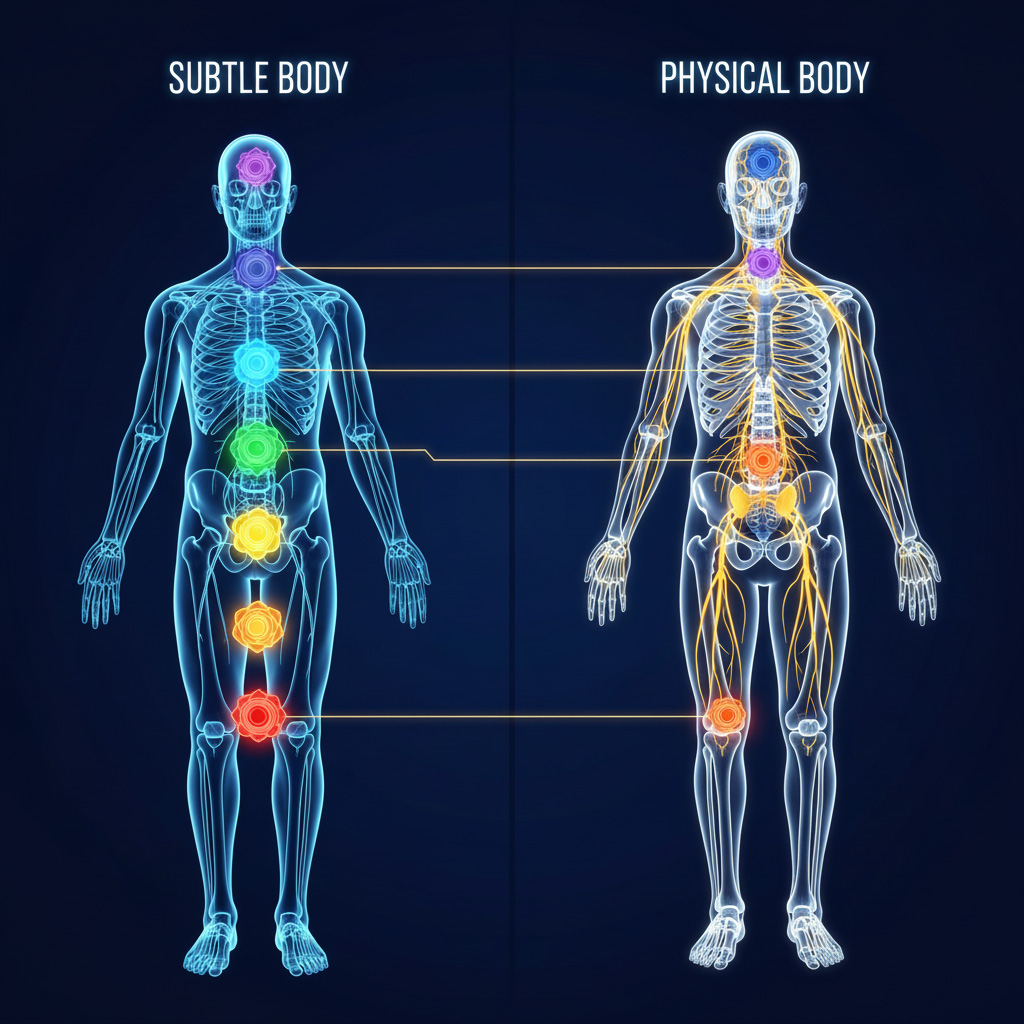
For thousands of years, yogic and Vedic traditions have described chakras - energetic centers in the body associated with specific physical, emotional, and spiritual functions. Modern sound healing assigns specific frequencies to each chakra, claiming these tones can "activate" or "balance" these energy centers.
Skeptics dismiss chakras as pre-scientific mythology. Believers treat them as literal energetic organs. But what if the truth is more interesting than either extreme? What if chakras represent an ancient, intuitive map of neurology, endocrinology, and biofield patterns that we're only now beginning to understand scientifically?
Let's explore what science can tell us about whether chakras are "real," how they correlate with measurable biology, and whether specific frequencies actually affect these systems.
What Are Chakras? The Traditional Model
The chakra system, primarily from Indian yogic traditions, describes seven primary energy centers aligned vertically along the spine:
- Root Chakra (Muladhara) - Base of spine
- Themes: Survival, safety, grounding, material security
- Traditional frequency: 396 Hz
- Color: Red
- Sacral Chakra (Svadhisthana) - Lower abdomen
- Themes: Creativity, sexuality, pleasure, emotional flow
- Traditional frequency: 417 Hz
- Color: Orange
- Solar Plexus Chakra (Manipura) - Upper abdomen
- Themes: Personal power, confidence, willpower, identity
- Traditional frequency: 528 Hz
- Color: Yellow
- Heart Chakra (Anahata) - Center of chest
- Themes: Love, compassion, connection, emotional healing
- Traditional frequency: 639 Hz
- Color: Green
- Throat Chakra (Vishuddha) - Throat
- Themes: Communication, expression, truth, authenticity
- Traditional frequency: 741 Hz
- Color: Blue
- Third Eye Chakra (Ajna) - Between eyebrows
- Themes: Intuition, insight, wisdom, perception beyond physical senses
- Traditional frequency: 852 Hz
- Color: Indigo
- Crown Chakra (Sahasrara) - Top of head
- Themes: Spiritual connection, consciousness, unity, transcendence
- Traditional frequency: 963 Hz
- Color: Violet/white
Traditional systems describe these as spinning wheels of energy (chakra means "wheel" in Sanskrit) that can be balanced, blocked, overactive, or underactive - affecting physical health, emotional wellbeing, and spiritual development.
The Skeptical View - Just Metaphor?
Modern skeptics reasonably point out:
- We can't see or directly measure chakras with scientific instruments
- No anatomical structures correspond exactly to chakra locations
- The system was developed before modern understanding of anatomy and physiology
- Many claims about chakras can't be tested empirically
But this critique may be too simplistic. Just because we can't measure something with current instruments doesn't mean the phenomenon doesn't exist - it may mean we're measuring the wrong things or using the wrong tools.
Depression is "real" despite being invisible. Love is real despite being unmeasurable. Consciousness itself exists despite our inability to locate or quantify it. Perhaps chakras represent experiential realities that don't fit neatly into reductionist Western scientific frameworks.
The Correlations - What Science Can Observe
While we can't measure "chakras" directly, fascinating correlations exist between chakra locations and modern understanding of neurology, endocrinology, and bioelectrical systems.
Chakra Locations Correspond to Nerve Plexuses
Root Chakra → Sacral plexus and coccygeal plexus
These nerve bundles control pelvic floor, elimination, and reproductive organs - directly related to "survival" and "grounding" themes.
Sacral Chakra → Lumbar plexus
Controls reproductive organs, bladder, and lower abdomen - matching "creativity" and "sexuality" themes.
Solar Plexus Chakra → Solar plexus (celiac plexus)
A major nerve center controlling digestion and stress response. This area literally tightens when we feel powerless or threatened - matching "personal power" themes.
Heart Chakra → Cardiac plexus
Controls heart function and contains a complex neural network. The heart has its own "brain" of approximately 40,000 neurons and generates the body's strongest electromagnetic field - matching "connection" and "love" themes.
Throat Chakra → Pharyngeal plexus
Controls throat, vocal cords, and thyroid - directly related to "communication" and "expression".
Third Eye Chakra → Pineal and pituitary glands
These master glands regulate circadian rhythms, consciousness states, and hormonal cascades. The pineal contains photoreceptor cells similar to the retina, lending credence to it being an "inner eye".
Crown Chakra → Cerebral cortex and upper brain structures
The seat of consciousness, self-awareness, and higher cognition - matching "spiritual connection" themes.
What this means: Chakra locations aren't arbitrary. They map onto genuine centers of neurological and endocrine control. Whether ancient practitioners perceived these through intuition, direct experience, or observation, they identified real centers of biological significance.
Chakra Themes Match Developmental Neuroscience
Psychologist and developmental researcher Dr. Anodea Judith has noted that chakra development mirrors child development stages:
- First 18 months (Root Chakra period): Infants develop trust, safety, physical security - root chakra themes.
- 18 months-3 years (Sacral Chakra period): Children explore sensuality, movement, emotional expression - sacral themes.
- 3-5 years (Solar Plexus period): Kids develop autonomy, willpower, identity - solar plexus themes.
And so on through development...
This correlation suggests chakras may represent developmental stages of nervous system maturation and psychological integration - a map of how consciousness and identity form over time.
Chakra Blockages Correlate with Psychosomatic Patterns
Clinical observation consistently shows:
- People with root chakra issues (safety, survival anxiety) often have digestive problems, lower back pain, or immune issues
- Those with heart chakra blocks (difficulty with love, connection) frequently develop cardiovascular issues or respiratory problems
- Throat chakra imbalances correlate with thyroid dysfunction and communication difficulties
Is this causation or correlation? Uncertain. But the mind-body connections are undeniable: chronic stress (third chakra) absolutely affects digestion. Suppressed grief (fourth chakra) correlates with heart disease. The correlations are too consistent to dismiss.
The Biofield Perspective - Energy That Can Be Measured
While "chakras" per se aren't directly measurable, biofields are. Your body generates measurable electromagnetic fields through:
- Heart electrical activity (EKG measures it)
- Brain electrical activity (EEG measures it)
- Cellular electrical potential
- Biochemical reactions creating charged particles
Research shows that the HeartMath Institute has documented the heart's electromagnetic field extending several feet from the body, while biofield imaging shows different patterns in different body regions. Some research suggests that what practitioners describe as "blocked chakras" correspond to areas of disrupted biofield patterns.
Hypothesis: Chakras may be experiential descriptions of biofield concentrations, electromagnetic vortices, or areas of high bioelectrical activity. We may eventually develop instruments sensitive enough to measure what practitioners have been sensing for millennia.
Frequencies and Chakras: Does Sound Affect These Centers?
Now to the practical question: Do specific frequencies actually affect chakras?
The Mechanism: Resonance
Every physical system has a natural resonant frequency - the frequency at which it vibrates most freely. When exposed to that frequency externally, the system resonates (amplifies vibration). This is established physics.
If chakras correlate with physical structures (nerve plexuses, glands, biofield patterns), those structures have resonant frequencies. Theoretically, exposing these structures to their resonant frequencies could create effects.
The Evidence: Limited But Suggestive
What we know:
- Different frequency ranges create different subjective experiences (low frequencies = grounding, high frequencies = expansive)
- This matches chakra theory (lower chakras = lower frequencies = grounding themes; upper chakras = higher frequencies = spiritual themes)
- Practitioners consistently report that specific frequencies create sensations in specific body regions corresponding to chakra locations
What we don't know includes whether the assigned frequencies (396, 417, 528, 639, 741, 852, 963 Hz) are objectively "correct" for those chakras, or whether the effects come from actual chakra activation or expectation.
The Solfeggio Frequencies: Ancient Tuning or Modern Invention?
The specific frequencies assigned to chakras (solfeggio frequencies) have an interesting history. While marketed as "ancient," the current system was largely developed in the 1970s by Dr. Joseph Puleo. No ancient texts explicitly assign these exact Hz values to chakras.
Does this invalidate them? Not necessarily. The question is: do they create beneficial effects experientially?
Using Frequencies for Chakra Work
Regardless of perfect scientific proof, millions of practitioners report benefits from chakra-frequency work. Here's how to approach it intelligently:
Working with Individual Chakras
- Root Chakra (396 Hz): When feeling ungrounded, anxious about survival/money, or physically depleted. Expect sensations of heaviness, settling, connection to body.
- Sacral Chakra (417 Hz): When creativity is blocked, emotions are suppressed, or sexuality feels disconnected. Expect emotional release, creative impulses.
- Solar Plexus Chakra (528 Hz): When feeling powerless, lacking confidence, or digestion is impaired. Expect increased vitality, clearer sense of self.
- Heart Chakra (639 Hz): When heart feels closed, relationships are difficult, or self-love is absent. Expect emotional opening, warmth in chest, tears.
- Throat Chakra (741 Hz): When communication is blocked, truth is suppressed, or thyroid issues arise. Expect desire to express, clearing throat sensation.
- Third Eye Chakra (852 Hz): When intuition feels blocked, mental clarity is lacking, or seeking spiritual insight. Expect forehead pressure, mental clarity, visions.
- Crown Chakra (963 Hz): When feeling disconnected from spirit/purpose or seeking transcendent experience. Expect top-of-head sensations, expanded awareness.
Full Chakra Alignment
Some practices layer all seven frequencies simultaneously, creating "full spectrum" activation. This aims for vertical alignment, balanced energy distribution, and whole-system coherence.
Combining Chakra Work with Other Practices
- Meditation: Use chakra frequencies as background during meditation focused on specific centers
- Yoga: Listen while practicing poses that target specific chakras
- Breathwork: Combine frequency with pranayama directing breath to chakra locations
- Visualization: While listening to chakra frequencies, visualize the corresponding color in that body region
- Somatic awareness: Notice actual physical sensations in chakra areas during frequency exposure
The Skeptical Practitioner Approach
You don't have to believe chakras are literal energetic organs to benefit from this system. Consider chakras as:
A useful map: Like any model, it's a tool for organizing experience and directing attention. Maps aren't the territory, but they help navigate it.
Somatic markers: Body regions that correspond to different emotional and psychological themes.
Integration framework: A way to ensure you're addressing physical, emotional, and spiritual dimensions.
The Bottom Line: Ancient Wisdom, Modern Application
Are chakras real? It depends on what you mean by "real".
- As discrete, measurable energetic structures: Not proven with current instruments.
- As meaningful correlations with neurology, endocrinology, and biofield patterns: Absolutely. The correlations are too consistent to dismiss.
- As experiential realities affecting wellbeing: Undeniably. Millions of people experience chakra-based practices as transformative.
- As a useful framework for holistic healing: Completely valid.
The ancient wisdom of chakras and the modern science of frequency healing can coexist productively. Perhaps chakras represent sophisticated, intuitive mapping of human neurophysiology developed through centuries of meditation and somatic observation. Perhaps we'll eventually prove they're measurable biofield phenomena.
Or perhaps the question of whether they're "real" in a reductionist sense misses the point entirely. They're real enough that engaging with them creates measurable improvements in wellbeing, consciousness, and life quality.
And that's the only proof that matters.